Get certified in trauma informed relationship therapy


NOW AVAILABLE — ON-DEMAND
join now and get instant access to the entire program.
Pay in full: $1600
6 monthly payments: $295
Includes lifetime access, certification, and personal instructor support. Begin anytime—your learning starts the moment you enroll.
The Complete Certification Package
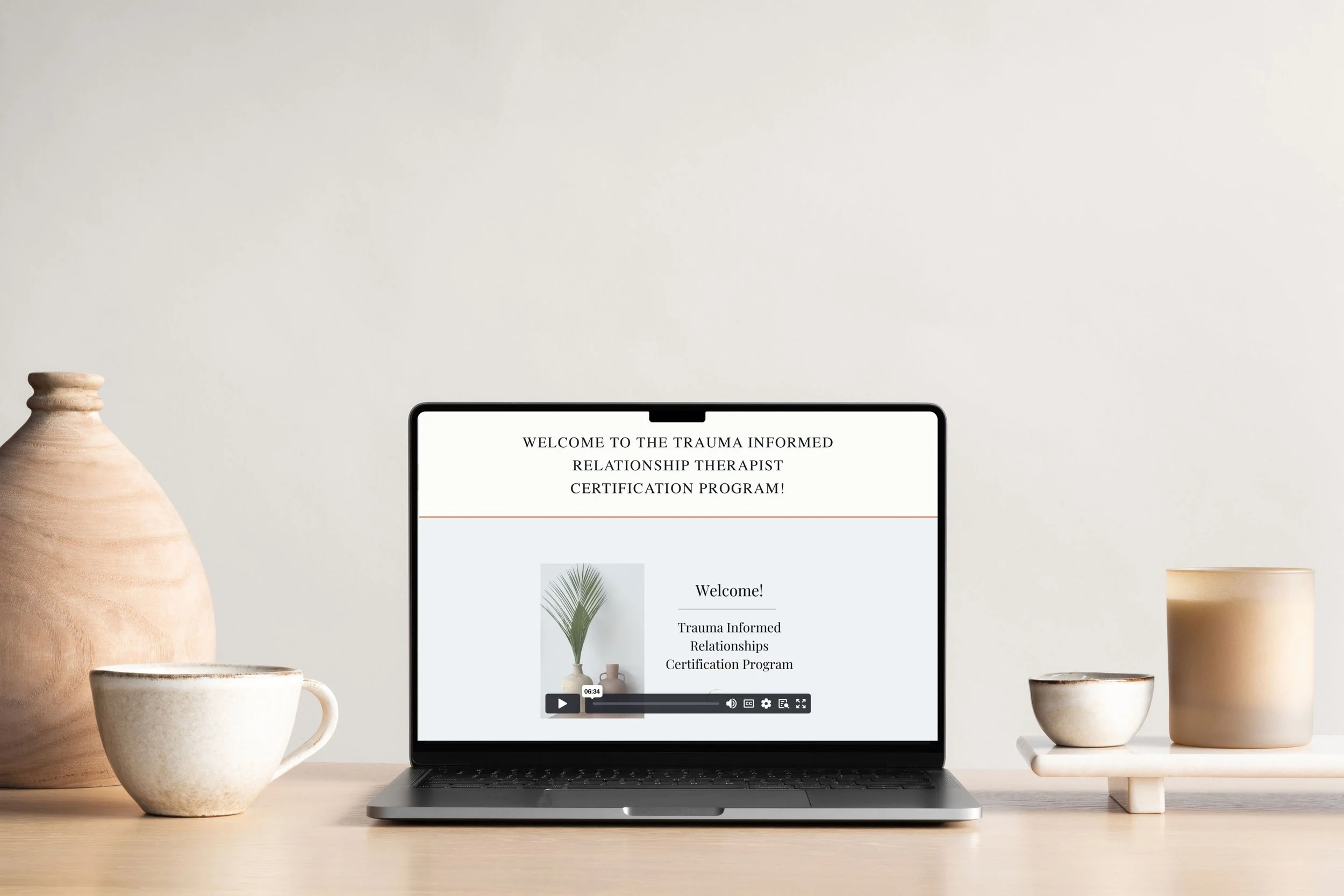
‣ 6 core modules of clinical training with 50 lessons and 24 hours of video instruction, focused on working with both individuals and couples
‣ 25+ handouts and resources to use in your practice, plus transcripts, slides, and reflection guides
‣ Bonus Module on business, marketing, and media training — essential professional skills often overlooked in traditional training programs
‣ Personalized Instructor Feedback — submit questions anytime within the program and receive direct written responses from Angela as you apply the material to your work
‣ Resource library of intake forms and specialized assessments
‣ Public Directory Listing of Certified Trauma-Informed Relationship Therapists, Counselors, and Coaches
‣ Certification Logo for your website, business cards, and materials
‣ Unlimited lifetime access to all course materials, including videos and downloads
‣ 30-day money-back guarantee — 100% refund if the program isn’t the right fit for you
Are you employed by a 501(c)(3) nonprofit organization?
We’ve got you covered. Contact us HERE for special pricing for nonprofit employees.
having a truly trauma informed approach to relationship issues is essential.
According to the National Center for Mental Health Promotion and Youth Violence Prevention, 60% of American adults report experiencing abuse or other difficult family circumstances during childhood. That’s nearly 200 million adults in the US alone.
Research suggests that approximately 10% of those who’ve experienced trauma go on to develop PTSD.
A far greater number of trauma survivors experience the aftermath of trauma in other ways: through anxiety, depression, and significant difficulties in intimate relationships.
Yet traditional treatments for trauma have overwhelmingly focused on reducing the symptoms of posttraumatic stress—namely reducing the intrusive thoughts, physiological hyperarousal, avoidance of trauma triggers, and dissociation related to traumatic events.
Treatments for PTSD that focus on reducing trauma activation (including EMDR, exposure modalities, EFT/tapping, Brainspotting, etc.) can be vital for trauma survivors.
But none of these approaches is designed to address the ongoing impact early trauma has on intimate relationships or change ingrained, destructive relationship patterns that continue to affect our clients long after the traumatic experience has ended … and even after symptoms of posttraumatic stress have been successfully treated.
This leaves a huge gap in support and healing for trauma survivors who desperately want to have healthy, fulfilling intimate relationships.
It shouldn’t be this way.
Clients with childhood trauma want and deserve hope—hope that their past experiences aren’t a life sentence for unhealthy relationships in adulthood.
This program offers a fresh approach to trauma training—one that focuses on the impact trauma has on intimate relationships—whether or not a client’s traumatic experiences ever developed into PTSD or C-PTSD.
Research estimates that 1 in 3 women, 1 in 3 men, and 1 in 2 nonbinary people will be in an abusive relationship at some point in their lives. This number represents a huge number of people in need of quality, trauma informed guidance and support.
As helping professionals, we know that intimate relationships are often a primary casualty of unhealed childhood trauma.
Studies consistently highlight trauma’s devastating impact on intimate relationships. And we all see the evidence of this in our offices every day.
We surveyed over 4700 adults about intimate relationships. 93% agreed with the statement: “I think it’s inevitable in relationships that each person’s past relationship wounds come up sometimes.”
More than ever before, clients are arriving at our offices already aware that their past experiences are negatively impacting their current relationships. They just don’t know what to do about it.
That’s where you come in.
Our certification in Trauma Informed Relationship THERAPY is unique.
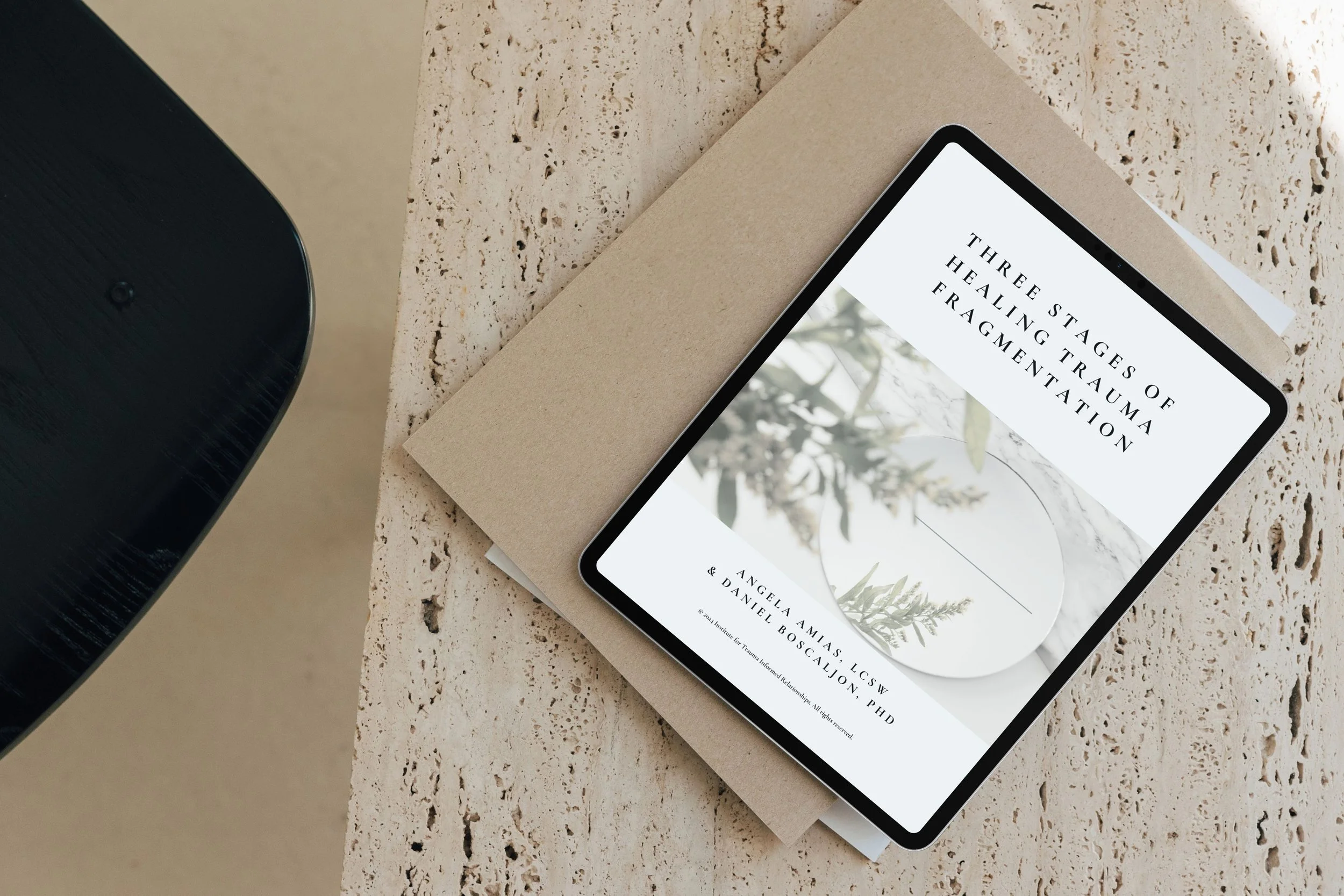
We go beyond what’s taught in other trauma treatment modalities, which focus on how to work with the Big T Traumas (the ones that often result in diagnoses of PTSD or C-PTSD). We address the effects of relational trauma that interfere with people’s quality of life and ability to create healthy, happy relationships.
With the rapid increase in public awareness about trauma over the last few years, far more people are desperately seeking guidance as they now recognize their own trauma for the first time.
The reality is that being effective in your work with those who have difficult or traumatic childhood histories requires a nuanced understanding of how small t traumas from childhood exert a powerful, detrimental influence on adult intimate relationships.
Here’s what you can expect when you sign up to become Certified AS A Trauma Informed Relationship THERAPIST:
‣ Deep confidence that your work with clients is highly effective
‣ Sharp insights into the roots of clients’ relationship issues
‣ Fresh skills that build trust with clients quickly, as you recognize patterns in their relationships and help them understand why they repeatedly get stuck in frustrating cycles
‣ Breakthrough results with clients who’ve struggled in therapy before, as you identify the deeper meaning of their recurring patterns
‣ Genuine appreciation for challenging clients (and their difficult partners) as you identify the traumatic underpinnings of defensive behaviors
‣ Greater success with clients who have a long history of toxic or abusive relationships, helping them step out of old patterns and create healthier relationships
‣ More fulfillment and less anxiety in your work as you develop a whole new toolbox of clinical skills
☞ Our certification program is designed to be straightforward, so you can get the training you need without extra costs and hoops to jump through.
☞ Receive the complete certification program, with lifetime access, without the requirement of additional levels of training in order to be fully certified.
Tools, Training, and Support—All in One Program
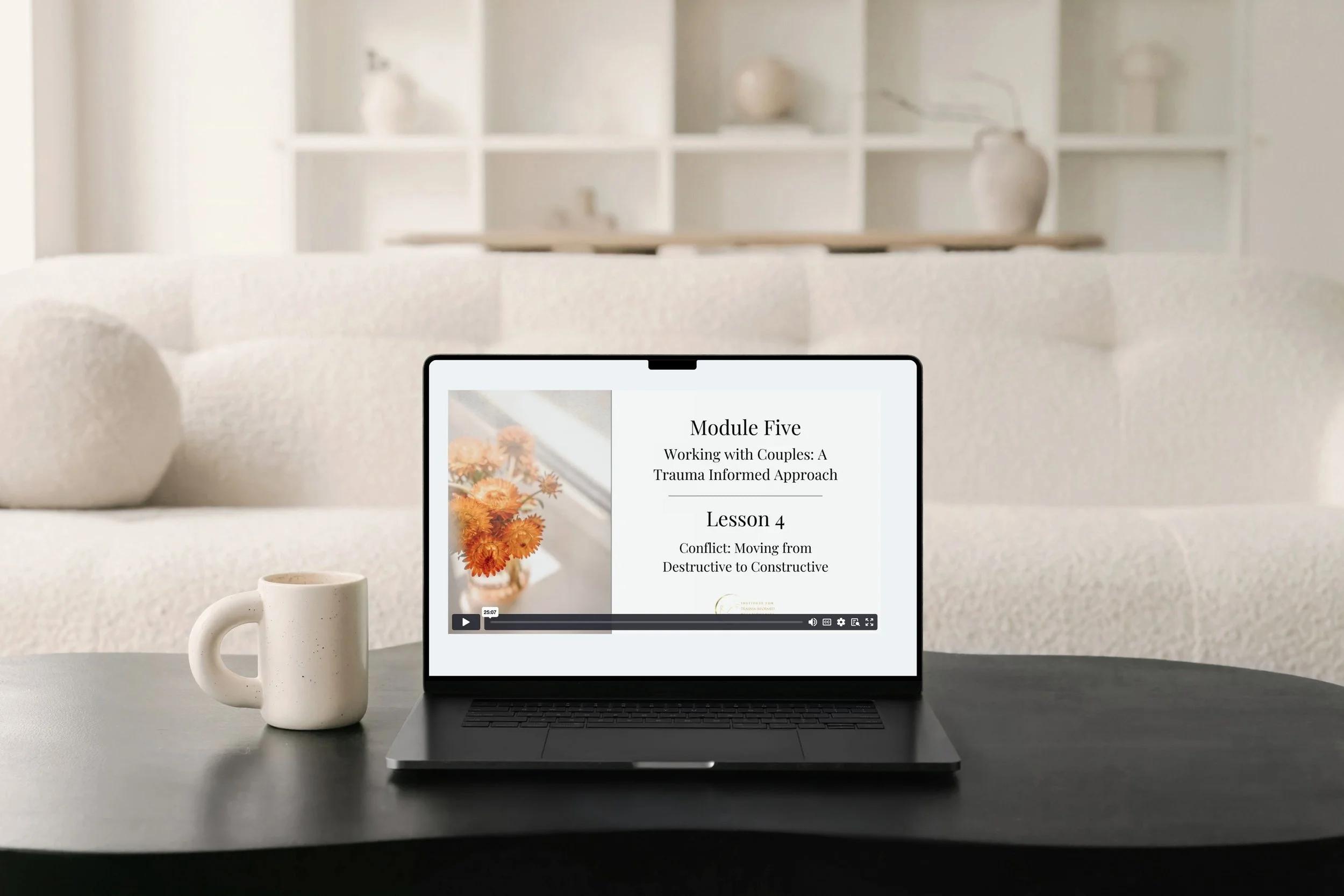
‣ 6 core modules of clinical training with 50 lessons and 24 hours of video instruction, focused on working with both individuals and couples
‣ 25+ handouts and resources to use in your practice, plus transcripts, slides, and reflection guides
‣ Bonus Module on business, marketing, and media training — essential professional skills often overlooked in traditional training programs
‣ Personalized Instructor Feedback — submit questions anytime within the program and receive direct written responses from Angela as you apply the material to your work
‣ Resource library of intake forms and specialized assessments
‣ Public Directory Listing of Certified Trauma-Informed Relationship Therapists, Counselors, and Coaches
‣ Certification Logo for your website, business cards, and materials
‣ Unlimited lifetime access to all course materials, including videos and downloads
‣ 30-day money-back guarantee — 100% refund if the program isn’t the right fit for you
Are you employed by a 501(c)(3) nonprofit organization?
We’ve got you covered. Contact us HERE for special pricing for nonprofit employees.
This is the Missing Piece in Trauma & Relationship Therapy
Our bet is that—whether you work with individuals, couples, or both—a large number of your existing clients are in need of the skills and fresh understanding you’ll gain from Trauma Informed Relationship Therapy training. Even before you finish the first module, we think you’ll instantly see where this approach will benefit your clinical work.
This program is the missing piece. Traditional trauma treatments are designed to reduce symptoms of traumatic stress. They’re not designed to address the problematic relationship patterns learned in childhood that continue to create difficulties in adult relationships. Trauma Informed Relationship Therapy is the perfect complement to other approaches to trauma treatment as well as other relationship counseling modalities.
Becoming a Certified Trauma Informed Relationship Therapist is a necessary step toward meeting an unmet need for those struggling with the effects of relational trauma from childhood. It offers new hope for your existing clients as well as potential clients in your area … who are desperately searching for relief.
People need effective therapy that helps them address underlying trauma-related issues from childhood that are impairing their adult relationships. With this training, you’ll be able to help clients understand what they learned about relationships early in life (that’s not helping them now) as well as quickly identify what they missed out on learning about relationships (that they need to learn) in order to have the kind of fulfilling relationships they deserve.
If you’ve ever felt at a loss when it comes to helping clients free themselves from repetitive, destructive patterns in their relationships, this is the program for you.
We believe so strongly in the effectiveness of this program, that we confidently offer a 30 day satisfaction guarantee. If this program doesn’t meet your needs, we’ll happily refund your money.
Hey there … I’m Angela Amias.
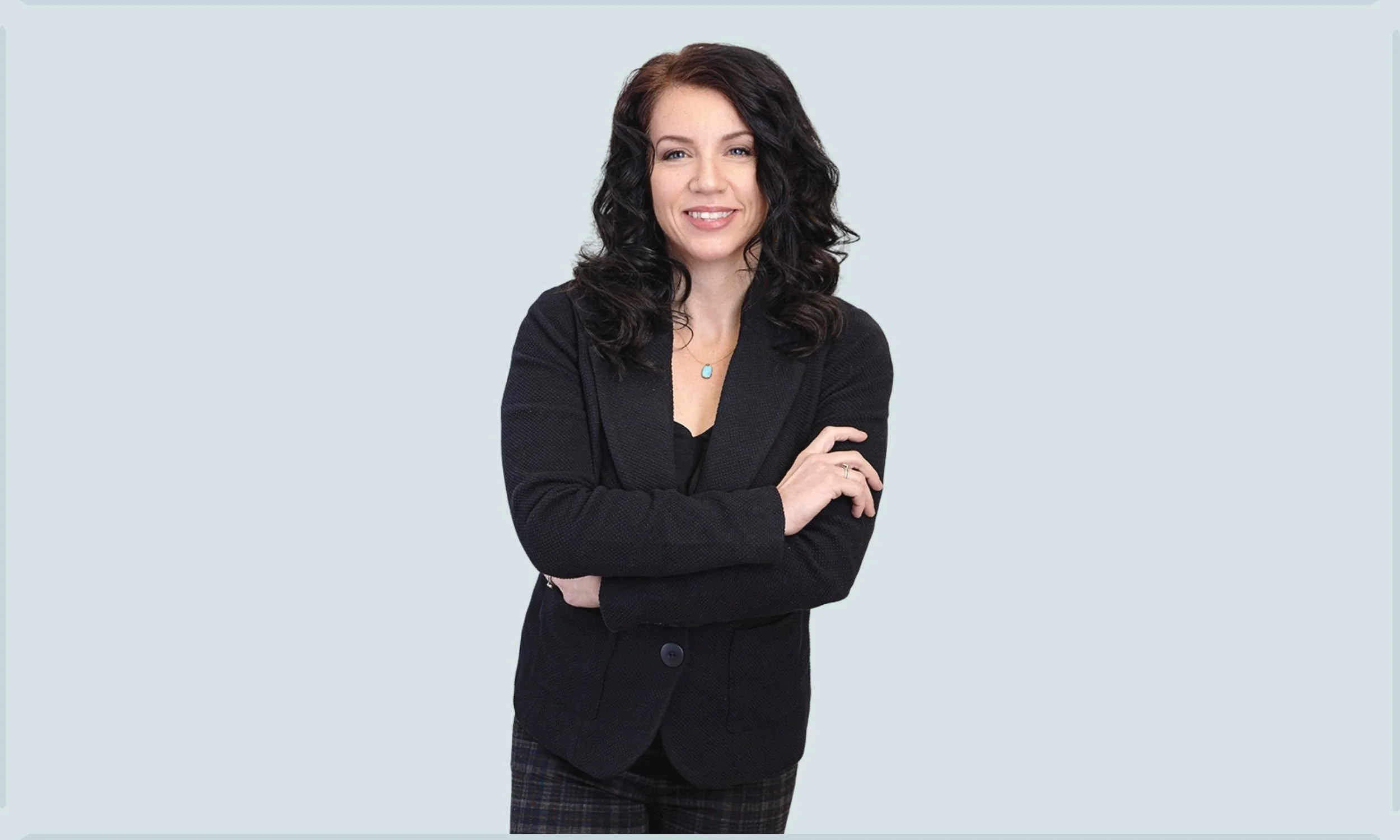
I developed the Trauma Informed Relationship Counseling for Individuals and Couples model of relationship therapy to bridge the gap between cutting edge research on relational trauma and traditional models for relationship counseling.
It’s the first comprehensive relationship counseling model that integrates a trauma informed approach to help both individuals and couples overcome relationship struggles and create more satisfying connections.
program highlights
What you get when you sign up
6 Modules of Clinical Training
Lessons are delivered through 50 recorded videos (24 hours total) with full on-demand access, so you can complete the training on your own schedule. Each module comes with handouts and reflection guides that highlight key points and give you practical tools you can bring straight into your sessions.
See below for detailed descriptions of everything covered in the training.
Personalized Instructor Feedback
Submit questions directly to Angela at any point during the program—whether it’s about a lesson, a case example, or how to apply the material in your own work. This ongoing support ensures you get personal guidance as you integrate new concepts and skills into your practice. For more in-depth support, you’ll also have the option to schedule an individual consultation with Angela at a special discounted rate—$50 off her standard fee—for program participants.
Assessments, Forms, & Interventions
You’ll gain access to a library of 27 handouts and specialized assessments, plus detailed instructions for interventions you can use with clients. The handouts are designed to save you time and provide clear frameworks you can adapt for your own practice. Assessments are copyrighted by the Institute, while intake forms can be customized to fit your clinical style.
Marketing, Business, & Media Training
This bonus module is dedicated to helping you reach your ideal clients and build your reputation as an expert in trauma and relationships. After certification, you’ll also have the option to be listed in our public Directory of Certified Trauma-Informed Relationship Therapists—a valuable way to increase your visibility and credibility. This module is not required for certification.
Certification Program Overview
Module one
UNDERSTANDING RELATIONAL TRAUMA
This opening module lays the foundation for Trauma-Informed Relationship Therapy. You’ll learn how relational trauma differs from other forms of trauma, how early experiences shape clients’ core wounds and relationship templates, and why so many people repeat painful patterns in adulthood. By the end of this module, you’ll have a clear framework for understanding how childhood absence, loss, and attachment injuries continue to affect your clients—and how to begin creating hope for change.
You’ll learn how to:
Define relational trauma (including the concept of absence trauma) and explain why it matters in clinical work
Recognize the two fundamental needs in relationships—authenticity and belonging—and the impact when one is sacrificed for the other
Identify clients’ relationship templates and core wounds from childhood, and see how they continue to shape adult intimacy
Understand the roles of trauma repetition, ambiguous loss, and attachment styles in perpetuating painful cycles
Module two
TRAUMA & INTIMATE RELATIONSHIPS
This module takes you deeper into the ways relational trauma shapes intimate partnerships. You’ll learn how childhood wounds amplify the natural tension between closeness and distance, why every couple is navigating multiple “relationships within the relationship,” and how trauma fragmentation, dissociation, and shame show up in adult intimacy. The training also equips you with practical tools for helping clients regulate emotions, identify the qualities of healthy love, and navigate toxic or emotionally abusive relationships with greater clarity and support.
You’ll learn how to:
Understand the core tension between closeness and distance in intimate relationships, and how trauma heightens this struggle
Recognize trauma fragmentation, dissociation, and trauma-based shame—and learn strategies for addressing each in your work
Guide clients in developing emotional regulation skills through attuned therapeutic connection
Teach the five essential qualities of healthy relationships and use the Six Questions for Relationship Clarity to assess them
Support clients in toxic or emotionally abusive relationships with a stage-based framework for intervention
Module three
FIVE CORE RELATIONSHIP STYLES
This module introduces the Five Relationship Archetypes—a powerful framework for understanding how core wounds, childhood experiences, and attachment patterns show up in adult relationships. You’ll gain insight into the gifts and challenges of each style, how they interact in couples, and how to guide clients from the limiting “shadow side” of their archetype toward genuine healing and growth. By the end, you’ll have a versatile tool for helping both individuals and couples recognize recurring patterns and create new possibilities in their relationships.
You’ll learn how to:
Understand the strengths, challenges, and core wounds of the Five Relationship Archetypes: Innocent Dreamer, Abundant Nurturer, Passionate Warrior, Hidden Gem, and Sunny Romantic
Recognize the shadow sides of each archetype and how they attempt to protect core vulnerabilities
Guide clients from archetypal “healing fantasies” toward real healing and deeper connection
Anticipate common dynamics in couples by exploring how different archetypes interact
Apply practical tips for working effectively with each style in therapy or coaching
Module four
THE INDIVIDUAL IN RELATIONSHIP
This module focuses on how clients can break free from trauma-based patterns and create healthier, more authentic connections. You’ll learn how the therapeutic relationship itself can serve as a powerful container for healing, and how to guide clients through dissolving old templates, recovering lost parts of the self, and building the skills they missed in childhood. From addressing enmeshment and individuation to navigating disillusionment and growth, this module equips you with a roadmap for helping clients reclaim themselves and develop more satisfying, resilient relationships.
You’ll learn how to:
Use the therapeutic relationship as a reparative experience that fosters healing and growth
Help clients dissolve trauma-based relationship templates and recover lost parts of the self
Teach core relationship skills clients may have missed in childhood, empowering them to form healthier bonds
Identify and interrupt repetitive trauma-driven relationship patterns
Support individuation, untangle enmeshment, and guide clients through relationship disillusionment
Apply the Trauma-Informed Growth Model of Intimate Relationships to map client progress and foster resilience
Module five
WORKING WITH COUPLES: A TRAUMA INFORMED APPROACH
This module brings everything together by focusing on how to apply trauma-informed principles in couples therapy. You’ll learn how intimate relationships can become a container for healing trauma, and how to equip couples with the skills they need to communicate, show empathy, be vulnerable, and navigate conflict productively. You’ll also explore strategies for addressing barriers to intimacy, repairing betrayal trauma and relationship wounds, and guiding couples through rupture and repair. By the end of this module, you’ll be able to recognize the hidden “contracts” and metaphors shaping couples’ dynamics and help them create a healthier, more resilient partnership.
You’ll learn how to:
Use intimate relationships themselves as a catalyst for healing unresolved trauma
Teach couples Reflect & Connect practices to improve communication, empathy, and vulnerability
Transform destructive conflict into constructive growth opportunities
Work with trauma-based barriers to closeness and intimacy
Support couples healing from betrayal trauma and relationship wounds
Apply the Four R’s (Rupture, Repair, Reconnect, Release) to strengthen resilience and trust
Identify secret relationship contracts and harmful relationship metaphors—and guide couples toward healthier ones
Module SIX
RECLAIMING WHOLENESS
This final module focuses on helping clients reclaim their authentic selves and integrate their healing into a new sense of wholeness. You’ll explore how to guide clients in distinguishing between trauma-based beliefs and their true self, support them through the grief process, and embody your role as a trusted guide in their journey. The module also introduces approaches to cultivating post-traumatic growth and narrative healing, so clients can move beyond survival into meaning-making and a renewed life story.
You’ll learn how to:
Help clients reclaim their true selves by separating trauma-based beliefs from authentic identity
Support clients through the grieving and mourning process, addressing common barriers to grief
Embody your role as expert guide and trusted companion in trauma recovery
Cultivate post-traumatic growth and help clients find meaning in their healing journey
Use narrative healing to guide clients in releasing trauma-based life stories and writing new, more authentic ones
bonus Module seven
MARKETING, BUSINESS, & MEDIA TRAINING
In addition to your clinical training, you’ll receive a set of resources designed to help you share your work in authentic, ethical ways that align with your values. These handouts and guides provide clarity on who you serve, how to reach your ideal clients, and how to position yourself as a trusted expert—without sleazy tactics or pressure-driven marketing. Whether you’re looking to grow referrals, increase your visibility, or explore media opportunities, this module will give you the tools to confidently take the next step in building your practice.
You’ll receive guidance on:
Marketing & Media Strategy Checklist — a simple roadmap for choosing the right strategies for your goals and avoiding the overwhelm of “trying to be everywhere.”
The Art of Referrals — guidance on building strong referral networks with colleagues and adjacent professionals.
Being Discoverable — practical steps to help potential clients find you easily (including tips for Google and online presence).
Establishing Your Expertise — ways to build authority outside of social media, through writing, podcasting, and more.
Your Guide to Pitching Articles & Podcasts — step-by-step advice for landing guest opportunities that raise your profile and connect you with new audiences.
Includes lifetime access, certification, and personal instructor support. Begin anytime—your learning starts the moment you enroll.
Pay in full: $1600
6 monthly payments: $295
Your Complete Certification Package
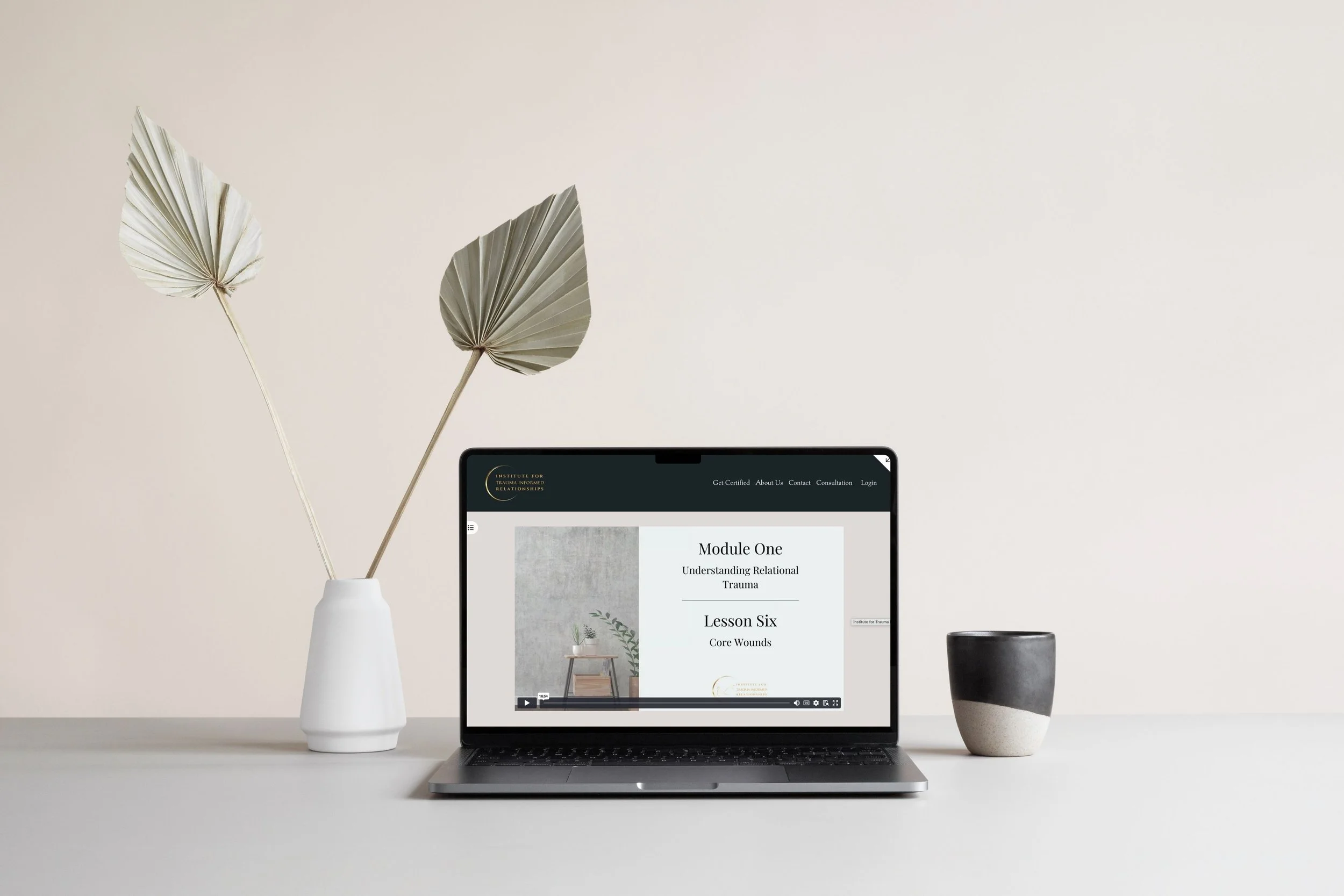
▹ Your enrollment fee gives you access to the entire certification program—no extra levels of training required and no additional supervision costs. Everything you need to become fully certified is included.
▹ Six modules of training on Trauma-Informed Relationship Therapy (effective with both individuals and couples)
▹ Personalized instructor feedback — submit questions anytime and receive guidance from Angela, with the option to book discounted individual consultations if you need additional support
▹ Lifetime access to all trainings, videos, and handouts
▹ 25+ professional handouts, assessments, and guided interventions
▹ Directory listing as a Certified Trauma-Informed Relationship Therapist (with free state-based listings for U.S. practitioners)
▹ Certification logo for your website, cards, and materials
▹ Bonus module on business, marketing, and media training
A Trauma-Informed Approach to Relationships
The impact of childhood relational trauma on adult relationships has been overlooked for far too long.
Most training in trauma treatment focuses on symptoms like PTSD or C-PTSD. But research shows only a small percentage of people with childhood trauma ever receive these diagnoses.
The truth is, the most common long-term outcome of childhood trauma isn’t PTSD — it’s difficulty with relationships. Struggles with intimacy, repeated cycles of conflict, and challenges in one’s relationship with self are often rooted in early relational experiences.
These early “small t” traumas — neglect, emotional absence, unpredictable caregiving — leave behind unhealed wounds that surface in adult life. They often underlie relationship problems, as well as experiences of depression, anxiety, and loneliness.
This certification program focuses on that intersection: where trauma and relationships meet. It offers a framework for understanding these patterns and working with them directly in clinical practice, supporting individuals and couples as they begin to relate differently—to themselves and to each other.
FAQs
-
You will have six months of access to Conversation and Connection Q&As with Angela, which are held on Zoom once a month. These are usually held on the second Friday of the month at 3:00pm ET /12:00pm PT. To protect confidentiality and privacy, these Zoom sessions are not recorded. If you are unable to make these sessions, you will also be able to submit questions to Angela, who will record a response and upload it to the course page as part of a Q&A library.
-
The certification program is designed to be completed over six months. While you’ll receive immediate access to all six modules (plus the bonus module), each one is structured to represent about a month of focused study. Altogether, the training includes 50 lessons and roughly 24 hours of video content, with Module 3 being the most in-depth.
Because the course is self-paced, you can watch the lessons and work through the handouts at times that fit your schedule. Many participants find that spending a full month on each module allows them to absorb the material deeply and apply it to their client work as they go.
Throughout the program, you’ll have the opportunity to submit questions directly to Angela for personalized feedback. And you’ll retain lifetime access to all course materials—so you can revisit the lessons, handouts, and resources anytime you want a refresher.
-
Yes—absolutely. One module of the program is devoted to working with couples. We expect that even if you don’t work with couples yourself, you will still get tremendous value out of the material in this section, because you work with individuals who are in intimate partnerships.
-
This program is completely unique because it approaches trauma from a relational lens, rather than the traditional focus on reducing symptoms of post-traumatic stress. We expect you will find this program to be an excellent complement to any other trauma modality you are already trained in.
-
No, you don’t. While you may decide to pursue additional training in a trauma modality like EMDR at another point, you do not need additional training to be able to apply what you learn in this program in your clinical practice. This is a comprehensive training program for helping your clients heal relational trauma.
-
Complete Modules 1-6. (7 is an optional, bonus training on business, marketing & media.)
At the end of each module, we’ll have some brief reflection questions for you to answer and submit to us as part of the certification process. (NOTE: If you are receiving CE credit, you will also need to complete a short quiz at the end of each module.)
Once you’ve completed Modules 1-6, you’ll submit one case study (minimum of 2 pages, double-spaced) describing how you integrated the material in this program in your work with an individual or couple.
-
We offer a 30 day 100% money back guarantee. We want you to love the program. But if you don’t, we want you to feel good about your experience working with us. That means promptly issuing a refund if you decide the program isn’t right for you.
-
Requirements for CEs differ by state. We will provide a Continuing Education Certificate if you fulfill the requirements of our course and request a certificate. However, this does not mean that these hours will count with your particular licensing board. Angela is licensed in the states of Colorado, Wyoming, Iowa, and Illinois. If you’re uncertain about whether this program qualifies for CEs with your licensing board, check with your regulatory agency to get clarity on this question.
Do you have a question that’s not answered here? Contact us.

Wondering if this program is right for you? Let’s chat.
We’re passionate about giving back

Helping those in need is something we take very seriously as part of our commitment to create a more loving, connected world. That’s why we donate 10% of our profits to charity.
Not only does becoming Certified in Trauma Informed Relationships enable you to make a bigger, better impact on those you serve, you can feel even better knowing that a portion of your registration fee is going to help others around the world.
Our 2026 charity of choice is GiveDirectly. We are proud to support their poverty relief work in the poorest regions of Africa.
About Us

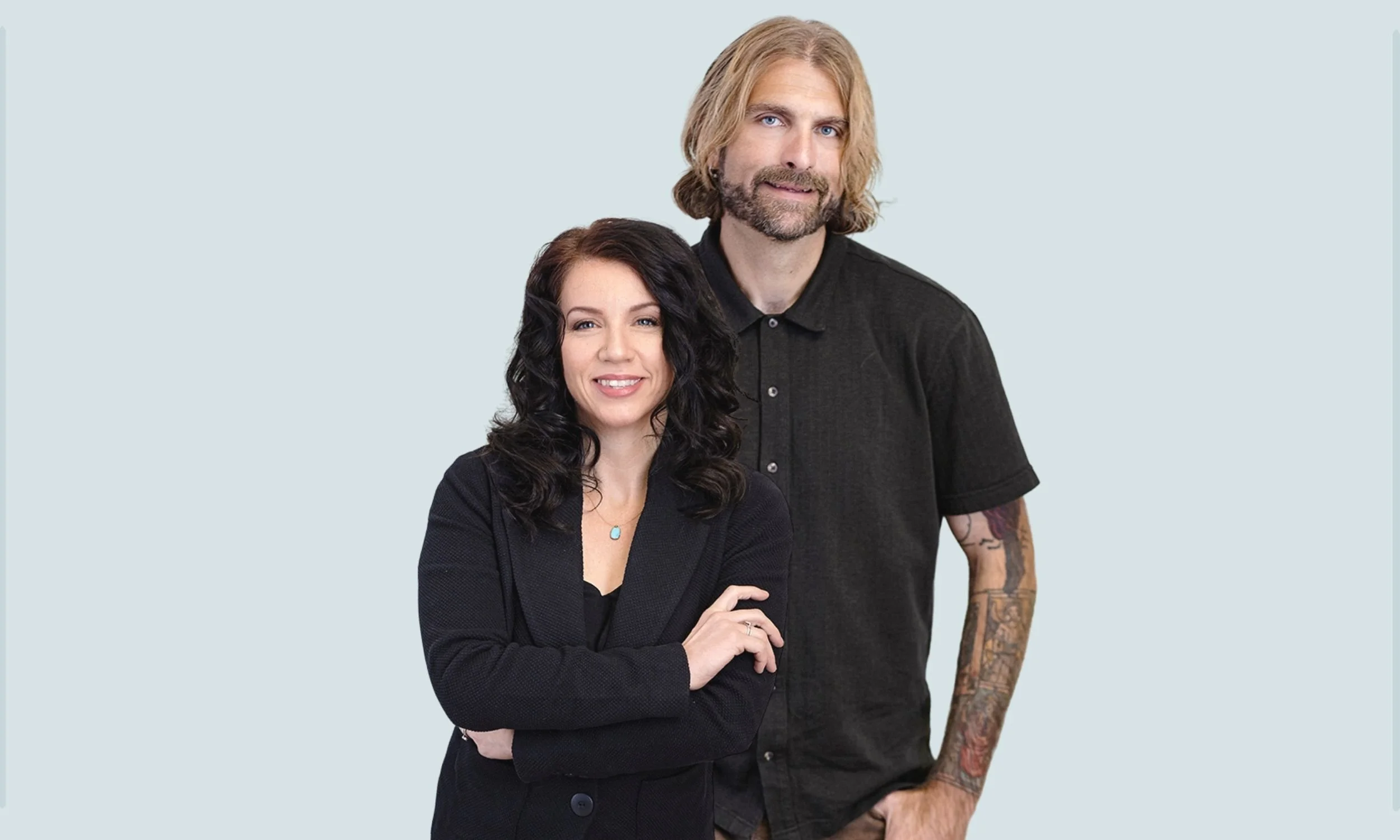
Angela Amias, LCSW
Founder & Clinical Director
Angela Amias, LCSW, is a relationship therapist whose work focuses on how early relational experiences shape the way people connect in adulthood. She is the founder of the Institute for Trauma-Informed Relationships and cofounder of Alchemy of Love, where she develops programs and resources focused on relationships after trauma.
Angela began her clinical work at a specialized attachment clinic serving adopted children with significant trauma histories. There, she worked with both children and their adoptive parents, helping families understand the inner world of the child while supporting the development of trust and connection.
When she left this role to become a therapist at a holistic healing center, working with women and men with depression, anxiety, and everyday relationship concerns, she imagined that her specialized skill set for treating attachment trauma would no longer be needed.
What she actually discovered was quite different.
The struggles her clients described in their romantic relationships often echoed the same dynamics she had seen earlier—though in less overt forms. Experiences such as emotional distance, inconsistency, or a lack of attunement had shaped how they related to themselves and others, often without being recognized as trauma.
Over time, this observation became central to her work. Many of the difficulties people encounter in relationships — cycles of conflict, challenges with intimacy, or a persistent sense of disconnection — can be understood in the context of earlier relational experiences.
This perspective informed the development of Trauma Informed Relationship Counseling for Individuals and Couples, a clinical framework that brings a trauma-informed lens to relationship work. The model focuses on helping clients understand how past experiences have shaped their relational patterns, and how those patterns continue to influence their current relationships.
Angela’s work also contributed to the development of the Five Relationship Archetypes, created with Daniel Boscaljon, which describes common relational patterns that emerge from early experiences and the meanings people make about themselves in relationship.
In addition to her clinical work, Angela has experience as a discernment counselor and divorce mediator, supporting individuals and couples navigating significant relationship decisions and transitions.
Her approach integrates psychodynamic and attachment-based perspectives with the use of therapeutic writing and reflective practices, supporting clients in making sense of their experiences and engaging more intentionally in their relationships.
Angela holds a Master’s in Depth Psychology from Pacifica Graduate Institute and a Master of Social Work from the University of Iowa. She’s currently a doctoral student studying analytical psychology at Pacifica Graduate Institute.
Her work has been featured in publications including Today, Oprah, Cosmopolitan, Well + Good, and Forbes. On the topic of relationships, she’s been a contributing writer for Inc. and Fatherly. As a trauma-focused practitioner, she’s a contributing author of the Clinical EFT Handbook.
Angela is also a mixed media artist. Her artwork has been exhibited in galleries across the United States and published in journals and magazines. She is also the co-creator of the Faces of the Divine Feminine Oracle.
Born and raised in Kansas City, Missouri, Angela now lives in Cheyenne, Wyoming. On sunny days, you can find her cozied up with a book or hiking in the mountains with Daniel.

Daniel Boscaljon, PHD
Co-Founder & Director of Program Development
Daniel Boscaljon, PhD, focuses on the role of meaning, narrative, and interpretation in shaping how people live, lead, and relate to one another. He is the co-founder of the Institute for Trauma-Informed Relationships and Alchemy of Love, where he contributes to the development of models and programs that integrate psychological insight with practical application.
Daniel’s work is grounded in an ongoing interest in the questions that shape a person’s life—how we understand ourselves, how we make meaning of our experiences, and how those interpretations influence the choices we make in relationships and in the world.
He studied English, Philosophy, and Religion as an undergraduate, and went on to earn two PhDs from the University of Iowa, in Religious Studies and English. His academic work focused on the ways stories, belief systems, and cultural frameworks shape human experience, as well as the role of psychoanalysis and narrative in understanding personal and collective challenges.
After several years teaching at the university level, Daniel shifted his focus toward working more directly with adults. His work has included leading workshops, facilitating group learning, and working one-on-one with individuals seeking to engage more intentionally with questions of purpose, leadership, and relationship.
At the Institute for Trauma-Informed Relationships, Daniel leads program development, helping to shape the structure and content of the training model. His background in narrative and archetypal psychology contributed to the development of the Five Relationship Archetypes, created with Angela Amias, as well as the Relationship Yes! Test, a brief framework for assessing relational health.
In addition to his work with the Institute and Alchemy of Love, Daniel is the founder of Peerless Leadership, where he works with organizations on leadership development, communication, and conflict.
Daniel’s work has been featured in publications including NBC News, Newsweek, Harper’s Bazaar, Forbes, and MindBodyGreen.
Born in California and raised in Iowa, Daniel now makes his home in the wilds of Wyoming. You can learn more about him at danielboscaljon.com.
featured in